Alexander-Sergei Ramírez


Sheila Arnold & Alexander-Sergei Ramirez
They have been performing together for several years in this rarely heard duo combination. They have frequently appeared at international festivals, such as the "Spannungen" Chamber Music Festival at the Heimbach Power Plant, the "Accordate" Chamber Music Concert Series (Aachen), the "Villa Domergue" Festival in Cannes (France), the Euriade Festival (Netherlands), the Styriarte Festival (Austria), the Schubertiade in Roskilde (Denmark), and the Koblenz Guitar Festival. They have also given concerts at venues including the Palacio de Torre Tagle in Lima (Peru) and for members of the Japanese Imperial Family. Numerous radio recordings (WDR, Deutschlandfunk, Belgian Radio, Austrian Radio, and Danish Radio) have been broadcast. Composers such as Stephen Goss, Frank Zabel, Jan van der Roost, Joaquín Clerch, and William Bland have written works for their duo. Their first joint CD was released in 2021 by Avi/Deutsche Grammophon: “very vital, powerful and expressive as well as immediately communicative interpretations that make this CD a pleasure,” (Staccato Magazine, Remy Franck) “These are fairytale-like sound mixtures! Enchanting colors! Magnificent!” (Rondo Magazine, Eleonore Büning).
Duo literature for guitar and piano? Original literature too? Oh, yes.
At the beginning of the 19th century, compositions for guitar and fortepiano were even very popular.
During the hundred years between 1780 and 1880, both guitar and piano making underwent enormous development, and the ideal sound changed approximately every 10 to 20 years. The fortepiano, in particular, evolved from an initially rich, overtone-laden sound, reminiscent of the harpsichord, to the warm and full sound of today's concert grand pianos.
Only in the relatively short period from 1810 to 1830 did the construction of the hammerklavier make it possible to develop qualities whose sonic result was more like that of a “romantic guitar” – similar possibilities of articulation, a similar timbre and volume, as well as an equally great variety of tone colors – than what we understand today as a “piano”.
The interplay of the two instruments creates the impression of a single, richly colored instrument – homogeneous and high in contrast.
Famous composers of this period, such as I. Moscheles (1794-1870), J.N. Hummel (1778-1837), A. Diabelli (1781-1858), and C.M. von Weber (1786-1826), were fascinated by the equivalence of the two instruments and were inspired to create captivating works. The Italian guitarist and composer Ferdinando Carulli (1771-1841), in particular, left behind a large number of original works and transcriptions for this combination, which he performed with his son Gustavo on numerous concert tours throughout Europe.
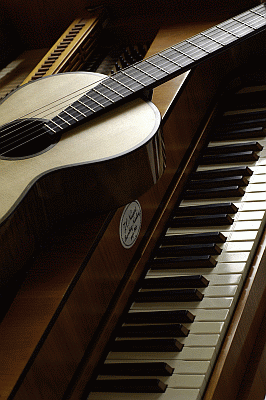
INSTRUMENTS:
Fortepiano:
Copy of an instrument by Louis Dulcken (c. 1815) JC Neupert, Bamberg
Louis Dulcken came from a long line of instrument makers. His grandfather, Joannes Daniel Dulcken, who worked in Antwerp and Brussels, was considered by contemporary judges to be the "best harpsichord maker in the line of the three Ruckers".
Johan Lodewijk Dulcken, the grandson born in Amsterdam in 1761, settled in Munich in 1780 under the name Louis Dulcken, where he became "mechanical court piano maker" as early as 1782 and gained high esteem at home and abroad during his approximately 50 years of work.
Neupert's replica is based on an original Louis Dulckens instrument made around 1815. Like a modern instrument, the grand piano is equipped with forte and una corda pedals. It also features a moderator pedal, which allows for the appropriate rendering of the performance markings "sordino" or "pianissimo" found in the piano literature of the time.
Romantic guitar
Copy of an original instrument by Georg Stauffer (1773–1853) by B. Kresse, Cologne (2006)
Romantic guitars—or Biedermeier guitars, as they are also known—are somewhat smaller and more delicate in design and have a brighter and more penetrating sound than modern concert guitars. Georg Stauffer was the most famous and influential guitar maker of the "Viennese School," which was experiencing a golden age of guitar playing at that time. Many innovations in guitar construction originated with him—the free-floating and height-adjustable fingerboard; it is no coincidence that many of his models were copied by other guitar makers in the 19th century.
Press kit
Duo Sheila Arnold & Alexander-Sergei Ramírez

Photo: Larissa Raiskin

CV English

CV English